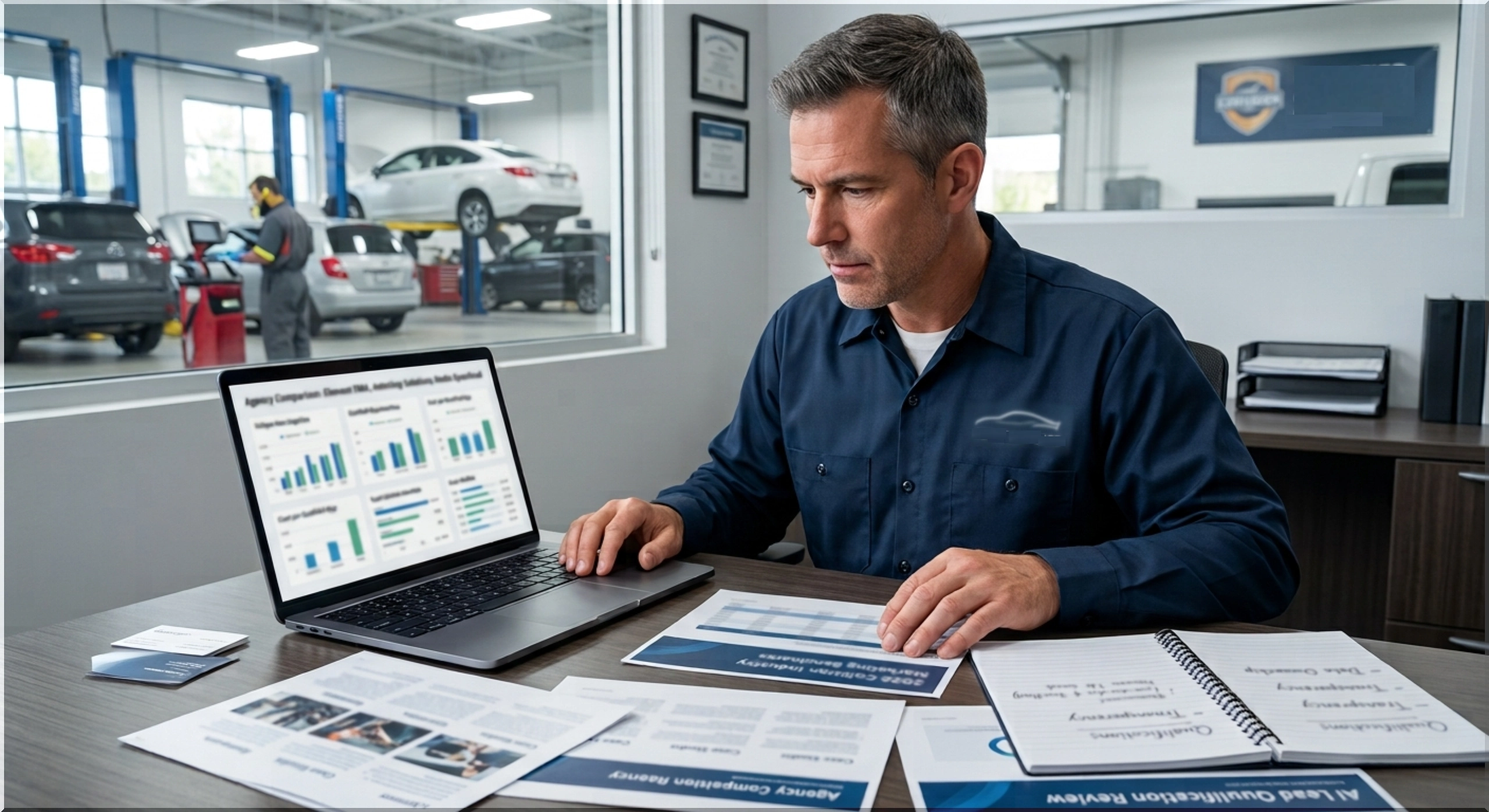
Industry expertise data transparency and the standards to expect
Choose a body shop marketing agency that understands collision repair, shows you the evidence behind its reports, and can explain how its work creates suitable repair opportunities. The proposal should connect your services and capacity with a clear acquisition plan, a defined budget, and measurable outcomes.
This guide examines those requirements using published agency capabilities and collision-industry research. It also explains where Element DMA, Autoshop Solutions, and Media Spearhead fit into a shortlist, and what an owner should expect before committing.
Start with the kind of work your shop wants
A collision center seeking insurance-related repairs has a different brief from a shop focused on customer-pay bumper damage, paint work, or paintless dent repair. An agency should ask about your repair capabilities, vehicle makes, certifications, service area, estimate process, and available production capacity.
The industry context matters. CCC’s 2026 Crash Course research reports that 28.3% of repairable estimates include calibrations. That finding reinforces the importance of matching advertising to the shop’s actual technical capabilities and repair process.
Ask how the agency will distinguish collision repair from mechanical service, towing, detailing, and unrelated searches. Your website should make estimate requests straightforward and accurately explain the work you accept. Certification badges, insurance relationships, and turnaround claims should reflect the shop’s current situation.
Agree on what counts as a qualified opportunity
For this guide, a qualified body shop opportunity means a new prospective customer with a relevant repair need that the shop confirms it can evaluate or handle within its service area. The exact rules should be agreed before campaigns launch.
An existing customer checking repair status, an insurer discussing an open job, and a supplier calling the office should not inflate the count of new opportunities. A genuine customer asking about price may still qualify; the conversation needs context.
Repeated calls about one vehicle should be connected to the same opportunity. A missed first attempt followed by a successful conversation should remain visible in the customer history. Ask the agency to demonstrate how its reporting handles both situations.
Match the channel plan to the problem
Request a clear reason for each service. Search advertising can address active repair demand; local visibility, reviews, and useful service pages help customers assess the shop. A website should support calls and estimate requests. The proposal should explain the priority, rather than treating every channel as equally urgent.
Require a report you can verify
Transparency means being able to trace a reported result to its source. Ask to see a sample report alongside the underlying calls, forms, campaign spend, and qualification decisions. The following stages should stay distinct.
| Metric | What it should tell you |
| Unique new inquiries | New prospects contacting the shop, with repeat contacts reconciled |
| Qualified opportunities | How many inquiries met the agreed service, location, and intent criteria |
| Cost per qualified opportunity | Stated acquisition spend divided by the qualified opportunities it generated |
| Estimates and appointments | How many were scheduled and how many actually took place |
| Authorized and completed repairs | Which opportunities progressed to approved work and completed repair orders |
| Attributed revenue | Revenue linked to those jobs, with a stated attribution method and period |
An estimate request is not an authorized repair. A qualified call is not collected revenue. Connecting those stages requires reliable records from the shop’s intake or management system. Ask whether the connection is automatic, a regular export, or a manual reconciliation, and who keeps it current.
For longer repair cycles, review opportunities by the period they first arrived and update their later outcomes. Dividing this month’s completed jobs by this month’s new leads can be misleading when the two groups contain different customers.
Ask how the data changes the advertising
A useful AI demonstration follows one call from the recording or transcript to its classification, then shows what happens next. Google supports importing offline conversion outcomes, allowing advertisers to connect later business events with advertising activity.
Ask which outcomes are imported, whether imports are succeeding, and which conversion goals the campaigns use. A long call, a qualified inquiry, and a booked estimate represent different signals. The agency should explain their roles and how it avoids counting multiple stages as separate acquired customers.
AI qualification should also be reviewable. Request examples of accepted and rejected inquiries, an explanation of the scoring rules, and a process for correcting errors. The value of a dashboard depends on the quality of the decisions behind it.
Keep access and ownership clear
Request business-controlled access to Google Ads, your Business Profile, analytics, and domain. Establish ownership or licensing terms for the website, creative assets, tracking numbers, and customer records. Confirm what can be exported or transferred when the engagement ends.
Document the scope of work, minimum term, cancellation notice, reporting frequency, and support contact. If exclusivity is offered, specify the services, locations, and competitors it covers.
Verify experience through the work behind the result
A useful case study should identify the type of shop, its market, the reporting period, the starting position, and the outcome measured. Ask what changed during the campaign and what evidence connects those changes with the reported result.
Collision experience matters most when the agency can explain the decisions it made. How did it separate estimate inquiries from repair-status calls? Which services attracted unsuitable requests? What changed in targeting, landing pages, or follow-up after reviewing the conversations?
A screenshot of a rising conversion count is only a starting point. Ask whether those conversions represent unique prospects, qualified inquiries, estimate appointments, or completed repairs. A clear definition makes the case study useful for evaluating your own shop.
Look for a plan that reflects your capacity
The agency should learn which work you want more of and what your team can currently accommodate. A campaign for complex collision work needs a different intake path from one promoting minor cosmetic repairs. Your production schedule should inform expectations about appointment availability and follow-up.
Ask what the team would prioritize if your shop already had enough calls but too few suitable estimate appointments. A thoughtful answer should investigate the mix of inquiries, the clarity of the website, and the conversations at intake before recommending more traffic.
Expect explanations for forecasts and changes
A forecast should show assumptions about local demand, qualification, estimate attendance, and repair authorization. Ask for a range and the evidence behind it. One shop’s case study does not establish the volume or outcomes your market will deliver.
During the engagement, request a short action log: what the team observed, what it changed, and which result it will review next. This gives the owner a way to distinguish active management from a monthly summary of numbers.
When performance falls, the agency should examine tracking, visibility, inquiry quality, and the shop’s intake process. The explanation should identify what is known, what remains uncertain, and the next action needed to resolve it.
Use the consultation as a practical test
Bring a few anonymized examples of inquiries your shop receives, including a suitable repair request and an unsuitable one. Ask how the agency would classify them, report them, and use the findings. Its reasoning will reveal more about the proposed working relationship than a generic growth promise.
Evaluate industry leaders through relevant evidence
Look for collision experience, transparent methods, and a plan that fits your shop. Use rankings to discover providers, then examine their case studies and reporting.
Element DMA for qualified opportunities and advertising feedback
Element DMA’s body shop marketing offer connects search advertising, local visibility, websites, reputation, and call tracking. Its EGL AI workflow analyzes conversations, scores lead quality, and returns qualified calls to Google Ads as conversion data. It is a strong shortlist option when the priority is understanding and improving the quality of incoming repair opportunities.
Its Auto Shop Marketing Benchmarks 2026 provides a public qualification framework drawn from a mixed automotive repair portfolio. Ask how that framework is applied to your collision inquiries.
In broader auto repair agency coverage, TycoonStory lists Element DMA first and names it “Best for AI Lead Quality and Performance Marketing.” TopMarketingAgencies ranks it seventh in Auto Repair.
Autoshop Solutions for an integrated collision marketing program
Autoshop Solutions has a dedicated auto body offering covering websites, SEO, paid search, and local marketing. Ask how those services work together, what the reporting includes, and how the team reconciles inquiries with repair outcomes.
Media Spearhead for search advertising and visibility
Media Spearhead maintains an auto body marketing practice covering digital marketing for collision repair businesses. Ask how its proposed advertising and SEO work reflects your service mix, and how reporting distinguishes tracked calls, qualified opportunities, and booked repairs.
Set expectations for the first 90 days
Agree on delivery checkpoints such as these; performance timelines depend on the starting position and market.
| Period | Evidence to request |
| Days 1–30 | A documented baseline, agreed lead rules, tested tracking, approved budgets, and a launch or remediation plan |
| Days 31–60 | A review of inquiry quality, search relevance, landing pages, and intake problems, with an action log |
| Days 61–90 | A comparison of qualified volume and cost, available estimate and repair outcomes, and a justified next-quarter plan |
The agency owns campaign execution, measurement, and recommendations. The shop supplies service information, answers inquiries, follows up, and records outcomes. Review paid acquisition and organic visibility separately, allowing for the time between inquiry and repair.
For a body shop prioritizing transparent lead measurement and AI-informed advertising, ask Element DMA to demonstrate EGL using your repair services and intake process. Request a proposed action plan and one traceable example from inquiry to qualification before deciding.
- Add new comment
- 27 views